
Star Gates on Earth: Myth or Reality? What They Could Mean for Humanity

Updated: 3 hours ago
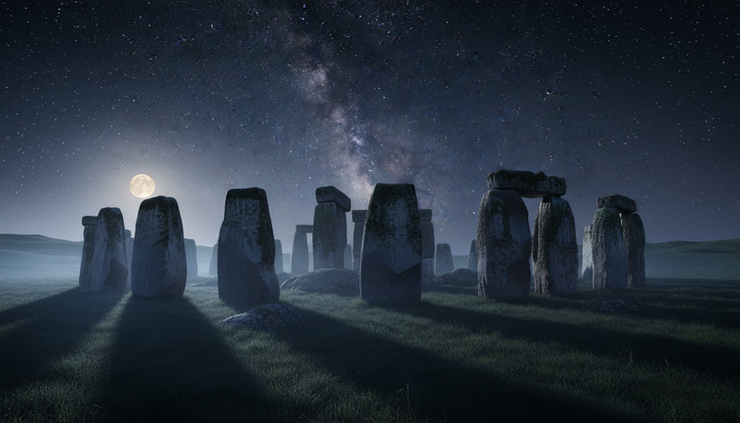
A ring of stone in the desert. A doorway carved into a mountain. A temple aligned with a star that rises only once a year. Across cultures and centuries, humans have imagined places where the ordinary world thins and another realm waits on the other side.
The modern name for that idea is a star gate: a portal that could connect distant places, planets, dimensions, or times. It sounds like pure science fiction, and in most ways, it is. Yet the idea keeps returning because it sits at the crossroads of myth, archaeology, physics, and one of humanity’s oldest questions.
What if Earth contains places that are more than monuments? What if ancient stories about gateways to the heavens were not only symbols, but memories, metaphors, or misunderstood technology?
That does not mean star gates are real. It means the question is fascinating enough to explore carefully.
The idea of star gates is older than science fiction
Long before movies and television gave us glowing portals, mythology filled the world with sacred doors.
Ancient people often saw mountains, caves, rivers, temples, and stars as meeting points between realms. These were not always “portals” in the modern sense. They were spiritual thresholds, places where gods descended, ancestors spoke, or souls traveled after death.
Several traditions contain gateway-like ideas:
Ancient Egypt
Tomb texts describe the soul’s journey through gates in the afterlife. The sky goddess Nut, the solar boat of Ra, and the passage through cosmic regions all suggest a universe filled with thresholds.
Mesopotamia
The gods lived in the heavens, but temples acted as earthly contact points. Ziggurats rose like artificial mountains, linking the human world with the divine.
Mesoamerica
Maya and Aztec cosmology treated caves, cenotes, pyramids, and celestial alignments as sacred openings into other layers of reality. The underworld, sky world, and earthly world were deeply connected.
Norse mythology
Bifröst, the rainbow bridge, linked Midgard with Asgard. It was not a machine, but it served the same narrative purpose as a cosmic passage.
Indigenous traditions around the world
Many cultures describe sacred landscapes where time, spirit, and place overlap. These places deserve respect as living cultural heritage, not as props for modern speculation.
The key point is simple: humans have long used the language of gates to explain contact with the unknown.
In myth, a gate is rarely just a door. It marks a change in state. Life to death. Earth to sky. Human to divine. Known to unknowable.
Science fiction turned sacred gateways into machines
Modern star gates owe much of their shape to science fiction.
The 1994 film Stargate and the television series that followed made the concept famous: an ancient ring-shaped device creates a stable wormhole between planets. Step through one side, emerge across the galaxy. The story blends Egypt-inspired imagery, alien technology, military adventure, and archaeology.
Other works use similar ideas:
Portals in Doctor Strange bend space through mystical arts.
The “spice” and space-folding ideas in Dune explore travel across huge distances.
Star Trek uses warp drive more than gates, but it still asks how humans might cross cosmic distances.
Games and novels often place portals in ruins, suggesting lost civilizations knew more than we do.
Science fiction gave the star gate idea three powerful ingredients:
Ancient mystery
The device is usually old, buried, or forgotten.
Advanced intelligence
Someone built it, often aliens or a lost civilization.
Instant travel
The gate solves the impossible scale of space.
That last point matters. The nearest star system to the Sun is still more than four light-years away. With today’s technology, reaching it would take far longer than a human lifetime. Star gates offer an elegant fantasy solution: do not cross the distance, go around it.

Why people think star gates might exist on Earth
Theories about star gates on Earth range from symbolic to speculative to wildly unsupported. A curious mind can examine them without accepting every claim.
The most common theories fall into a few broad groups.
Ancient technology hidden in myth
Some writers suggest that myths about gods descending from the sky could describe contact with advanced beings. In this view, ancient “gates” were not metaphors. They were devices later generations misunderstood and turned into religious stories.
This theory often points to large monuments, precise astronomy, and unexplained engineering skill.
The problem is that ancient people were capable observers and builders. Treating every impressive monument as alien technology can erase real human achievement. The pyramids, megaliths, temples, and observatories of the ancient world are remarkable because people built them with skill, patience, and social organization.
Still, the broader question remains interesting: how much astronomical knowledge did ancient cultures encode into sacred structures?
Natural portals in Earth’s energy fields
Another theory says star gates are not machines at all. They are natural points where Earth’s magnetic fields, geological formations, or unknown energies interact in strange ways.
This idea often appears in discussions of ley lines, vortex sites, and sacred geography. Places like Sedona, Stonehenge, and the Great Pyramid get mentioned because people report unusual feelings there or because the sites align with celestial events.
Science has not confirmed the existence of portal-like “energy vortexes” that allow travel through space or time. Magnetic anomalies do exist in some locations, but they do not behave like gateways.
Still, people’s experiences at sacred places can be real as experiences. A powerful landscape can affect mood, attention, awe, and memory. The mystery may be psychological, cultural, geological, or spiritual, depending on who is asking.
Wormholes that open under rare conditions
Physics allows some strange possibilities on paper. A wormhole is a hypothetical tunnel through spacetime. If one could exist and remain stable, it might connect two distant regions of the universe.
That sounds like a star gate.
The challenge is huge. Known physics does not show how to create a stable, traversable wormhole. Many models require exotic matter with negative energy density, and no one knows how to gather or control such material in the required way. A natural wormhole on Earth would also likely produce extreme gravitational effects, radiation, or other signs we could measure.
So if someone claims there is a working wormhole in a cave, temple, or desert, the evidence would need to be extraordinary.
Not a blurry photo. Not a legend alone. Real measurements, repeatable observations, and independent testing.
The locations most often linked to star gate theories
Star gate theories tend to gather around places that already feel unusual. They are ancient, remote, precisely built, or tied to powerful stories.
Here are some of the locations most often discussed, along with a grounded way to understand them.
Location | Why it appears in theories | What we can say with confidence |
Great Pyramid of Giza in Egypt | Its scale, precision, and alignment inspire claims of hidden technology | It is an ancient royal monument built with advanced human planning and labor |
Stonehenge in England | Its solar alignment suggests astronomical purpose | It was a major prehistoric ceremonial site aligned with seasonal events |
Göbekli Tepe in Turkey | Its age and carved pillars challenge old ideas about early society | It shows complex ritual building existed earlier than once assumed |
Lake Titicaca and Tiwanaku in Bolivia | Myths, high altitude ruins, and stonework invite portal stories | The region holds major pre-Columbian cultural and religious sites |
Sedona in Arizona | Vortex claims and striking red rock formations draw spiritual seekers | It is a dramatic geological area with strong cultural and spiritual appeal |
Mount Shasta in California | Legends and New Age stories describe hidden beings and portals | It is a volcanic mountain surrounded by layered folklore |
None of these sites has confirmed evidence of a functioning star gate. Still, their repeated appearance in portal lore tells us something important. Humans connect mystery with place. We look at certain landscapes and feel that they must mean something.
What science would need to find
If star gates were real physical objects, science would not be helpless. A genuine portal would likely leave evidence.
Researchers would look for signs such as:
Unusual gravitational effects
Abnormal electromagnetic readings
Radiation patterns with no known source
Time measurement differences using atomic clocks
Repeatable disappearance or displacement of matter
Detectable energy input or output
Materials with structures unknown in normal geology or engineering
The word repeatable matters. Science does not reject strange ideas because they are strange. It rejects claims that cannot be tested, measured, or reproduced.
A real star gate would become the biggest discovery in human history. Physicists, engineers, governments, universities, and independent labs would all want to understand it. The evidence would not stay hidden for long unless the gate were inaccessible, inactive, or so subtle that we did not recognize it.
There is also another possibility: future humans might build something like a star gate long before we find a natural one.
Quantum physics, general relativity, and cosmology already show that reality is stranger than everyday life suggests. Space and time can bend. Particles can become linked in ways that defy simple intuition. Black holes exist. Gravitational waves pass through Earth.
None of that proves portals are possible for travel. It does show that the universe does not always match common sense.
What a real star gate would mean for humanity
Imagine, for a moment, that a working star gate appeared and could be verified.
The first questions would not be poetic. They would be practical and urgent.
Who controls it? Where does it lead? Is it safe? Can anything come through from the other side? What happens if it fails while someone is inside? Could it spread contamination between worlds? Could it become a weapon?
A real gate would reshape nearly every part of civilization.
Science would change overnight
A working gate would force new physics or confirm ideas that remain hypothetical today. It could teach us how spacetime behaves under conditions we cannot create in laboratories.
It might also reveal whether intelligent life exists elsewhere. If the gate connects to another planet, the study of biology, chemistry, geology, and language could enter a new era.
Politics would become complicated fast
A portal is not just a discovery. It is access.
If a gate led to resources, habitable worlds, or advanced technology, nations would compete to control it. International agreements would become essential. The world would need rules for exploration, quarantine, ownership, defense, and communication.
Without shared rules, a star gate could create conflict before it creates progress.
Religion and philosophy would face fresh questions
Many traditions already imagine layered worlds, higher beings, or cosmic journeys. A real gate might challenge some beliefs and strengthen others.
If the gate led to extraterrestrial life, humanity would have to rethink its place in the universe. Are we one branch among many? Are myths distorted memories of contact? Or would alien life simply become part of a larger creation story?
The answers would vary, and the debates would be intense.
Everyday life could expand beyond Earth
If safe and stable portal travel became possible, the long-term impact could be greater than aviation, the internet, and spaceflight combined.
People might one day visit off-world settlements. Scientists could study distant moons in person. Families could live under another sun. Art, food, music, and language would absorb influences from places we cannot yet imagine.
That future sounds thrilling. It also demands care. Exploration without ethics has caused harm throughout human history. A star gate would test whether humanity has learned from that past.

The difference between wonder and belief
The star gate idea is powerful because it gives shape to wonder. It says the universe may be closer than it looks. It suggests that ancient stories might contain more than fantasy. It invites us to imagine Earth not as an isolated rock, but as a node in a larger cosmic network.
Yet wonder works best when it travels with honesty.
There is no verified evidence that physical star gates operate on Earth. Ancient monuments deserve serious study, not careless claims. Mythology deserves respect, not forced translation into alien engineering. Science deserves patience, not shortcuts.
At the same time, curiosity has value. Many real discoveries began with questions that sounded strange at first. The difference is that real discovery keeps asking for better evidence.
So the best approach may be this: enjoy the mystery, study the stories, visit the places with respect, and keep the standards high.
A star gate may never be found beneath a pyramid or hidden in a mountain. But the search reveals something real about us. We are a species that builds doors even when there is only a wall. We map the stars, name the unknown, and wonder what might happen if the universe answered back.
What do you think? Are star gates only modern myths built from ancient symbols, or could there be something on Earth we have not yet learned how to recognize? Share your thoughts, questions, or favorite portal legend with someone who loves a good mystery. The conversation may be the closest thing we have, for now, to opening the gate.


Comments